THIS TATTOO MACHINE USED TO BE A DISPOSABLE VAPE
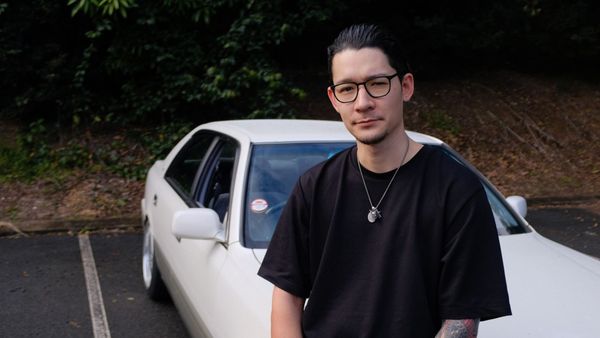
Philip Island tattooist Connor Cardus spent years wiring buildings. Now he's pulling apart disposable vapes and turning them into tattoo machines. It started because he couldn't bring himself to bin a battery.

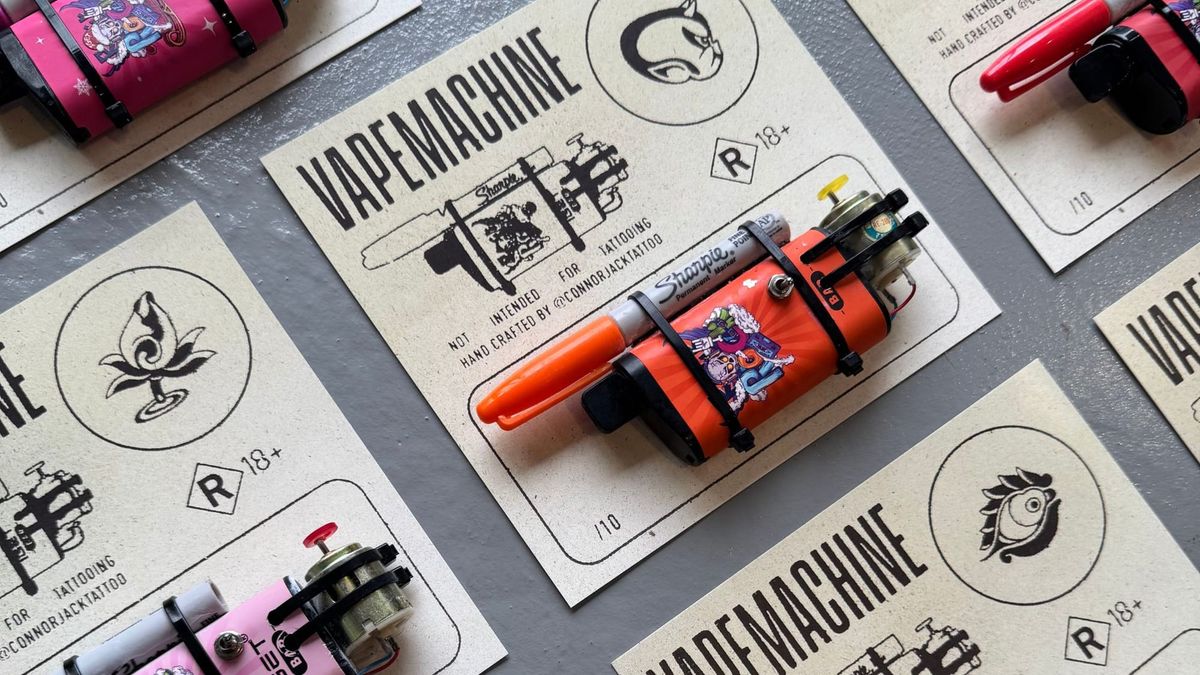
At the Rainforest & Reef Invitational (@rainforestandreefinvitational) in Cairns earlier this year, the PIT Studio (@pit.studio_) crew had a table covered in flash. Good flash. The kind of work that makes you stop walking and start looking. But it was the objects sitting alongside it that were impossible to ignore.
They looked like vapes. Because they were vapes. Except they weren't.
Connor Cardus (@connorjacktattoo) — tattooist, ex-sparky, Philip Island local — had built tattoo machines out of disposable vapes and brought them to Far North Queensland. In the middle of one of the best tattoo expos this country has seen, surrounded by some seriously talented artists, people kept gravitating back to the table to pick them up, turn them over and ask the same question: wait, is this actually running?
It is. And here's how it got there.
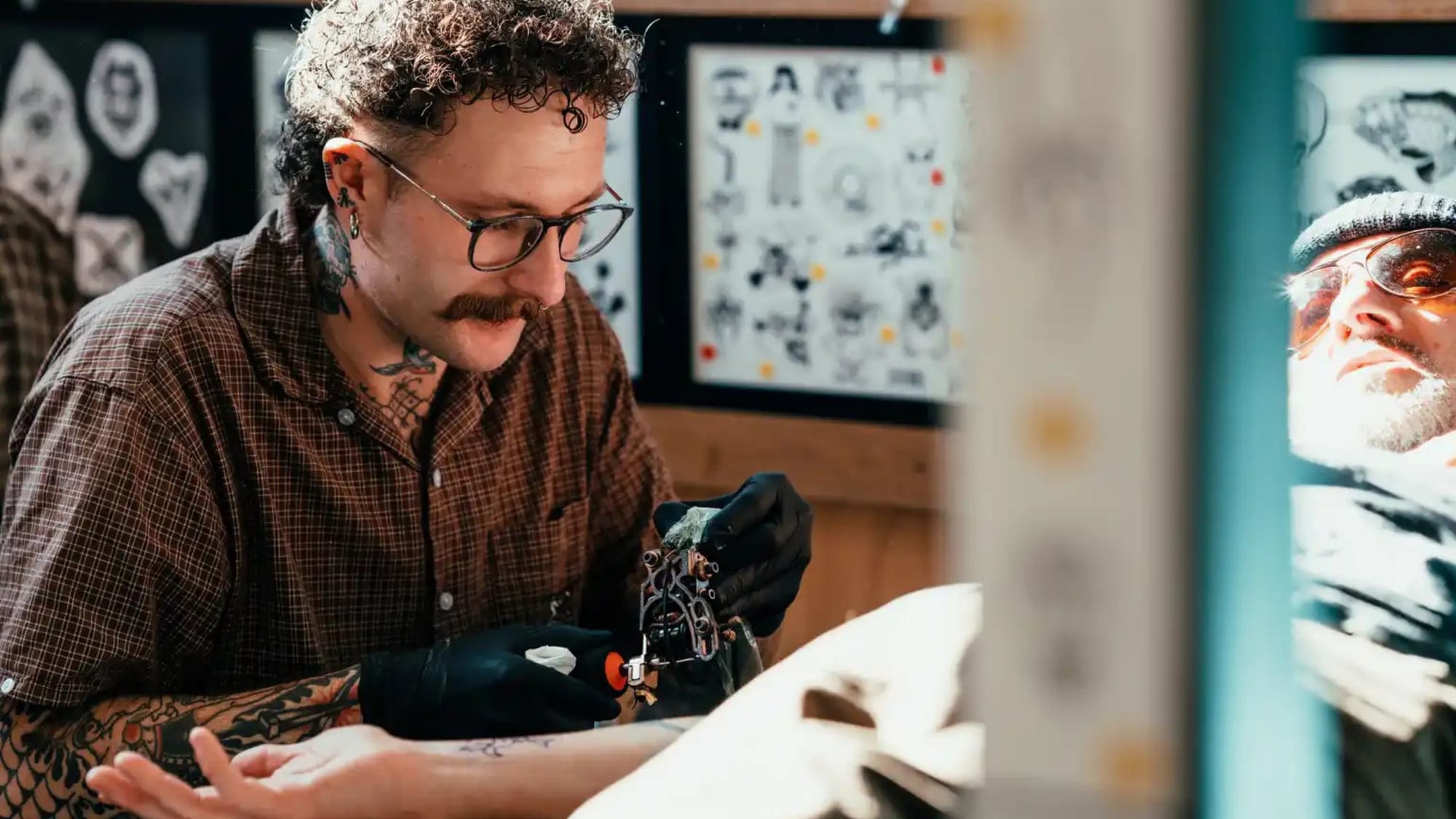
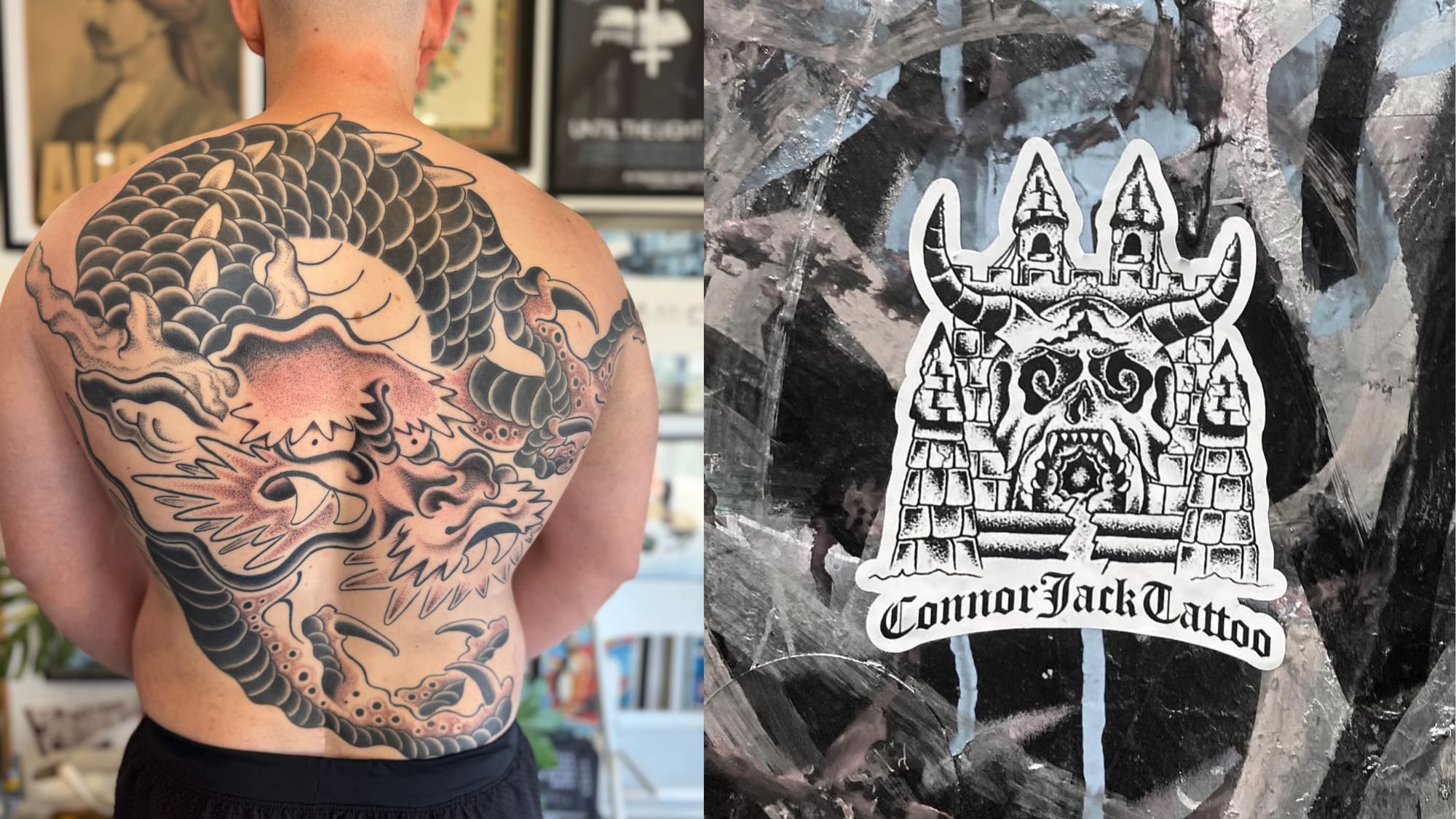
Connor has been tattooing for five years, most of that at PIT Studio (@pit.studio_) on Philip Island alongside Bugsy (@bugsy3922) and Jack Montgomery (@jmontgomery_tattoo). He's still developing his style — five years in, he's honest about that — but his interests sit firmly in Japanese and traditional. The kind of tattooing that rewards patience, study and a genuine respect for where it comes from.
The interest in tattooing goes back further than five years though... way further.
"I first came across tattoos in primary school when I found a library book called TATAU — it was about tattooing in the Pacific Islands," he says. "I was hooked." By fifteen he had machines and practice skins. By the time he actually started properly, he had hours of bad habits to unlearn. It didn't matter. He already knew this was it.
Before tattooing took over, he was an electrician. The kind of person who needs to understand how things work — not just that they work, but why, and what happens when they don't. That instinct didn't go away when he switched trades. If anything, tattooing sharpened it.
The vape machines started as a joke between friends. Not a throwaway joke — a proper one, with a point behind it.
"I'd been tinkering at home with building tattoo machines for myself and friends," Connor says. "I've always been one to build and create things, particularly out of completely unrelated items. I guess what inspired me to build a vape machine was seeing how normal vapes have become in today's society. Making a mockery out of it was something I liked the idea of."
A friend gave him a vape. He doesn't use them himself. It sat on his bench and then — the way things do when your brain is wired a certain way — he started pulling it apart. What he found inside was a lithium battery, a heating element, a reservoir. And a question.
Could this bad boy run a needle?
He pulled apart five more vapes working out the answer. Set two batteries on fire in the process. Broke a few motors. Found wiring diagrams on the internet and drew out circuit ideas until something clicked. The first iteration was done over a weekend. It wasn't pretty. It worked.
"I had the first one completed over a weekend — but not as simply as that sounds," he says. "A small price to pay for the understanding the failures gave me."
The build process is more considered than you'd expect from something that started as a mockery.
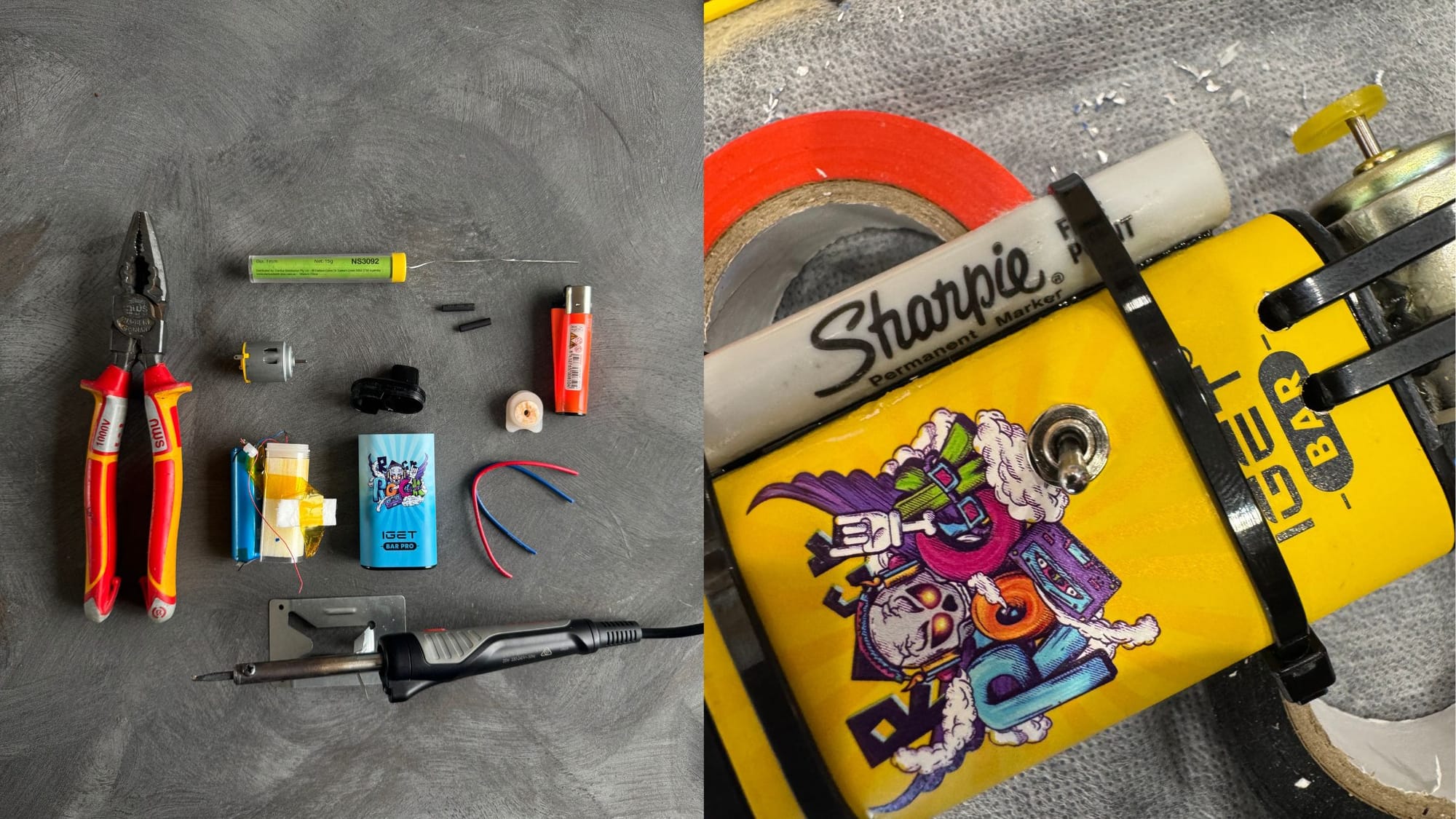
Strip out the reservoir and the mouthpiece. Keep the battery — and here's the thing that Connor keeps coming back to, the detail that genuinely bothers him about vape culture — that battery is lithium. The same lithium used in cameras, power tools, smartphones and electric cars. A sought-after resource, increasingly critical to how we power the modern world. And it's being thrown into landfill by the millions.
"Next time you're out, make mental notes of how many vapes you see — discarded on the ground or people vaping," he says. "It is everywhere. Now think about the fact that in each vape lies a battery that can be used to power all manner of things. In most cases all of these batteries are rechargeable, yet they are marketed to be thrown into landfill. To me that is testament of today's attitude. Nothing is made to last. Nothing is permanent. It's created to throw away."
He selects the motor carefully — he's settled on one he rates — drills holes in the vape body, cable ties and glues the motor in place, solders everything together. A basic on/off switch between the battery and motor. A button as a cam. And then — his favourite detail, the one that makes the whole thing make sense aesthetically — he grabs a Sharpie, pulls it apart, and uses it as the tube.
"I don't want these machines to look well made and proper," he says. "I like that they are made from what could be considered rubbish."
The inspiration for the whole concept came from somewhere older and more primal than you might expect. Prison tattoo machines. The idea that even with the most limited resources imaginable, people find a way to make tattoos. That the urge to mark the body is so fundamental it can't be stopped by the absence of proper equipment.
"For thousands of years, humans have decorated our bodies regardless of how limited our resources are," Connor says. "It's primal."
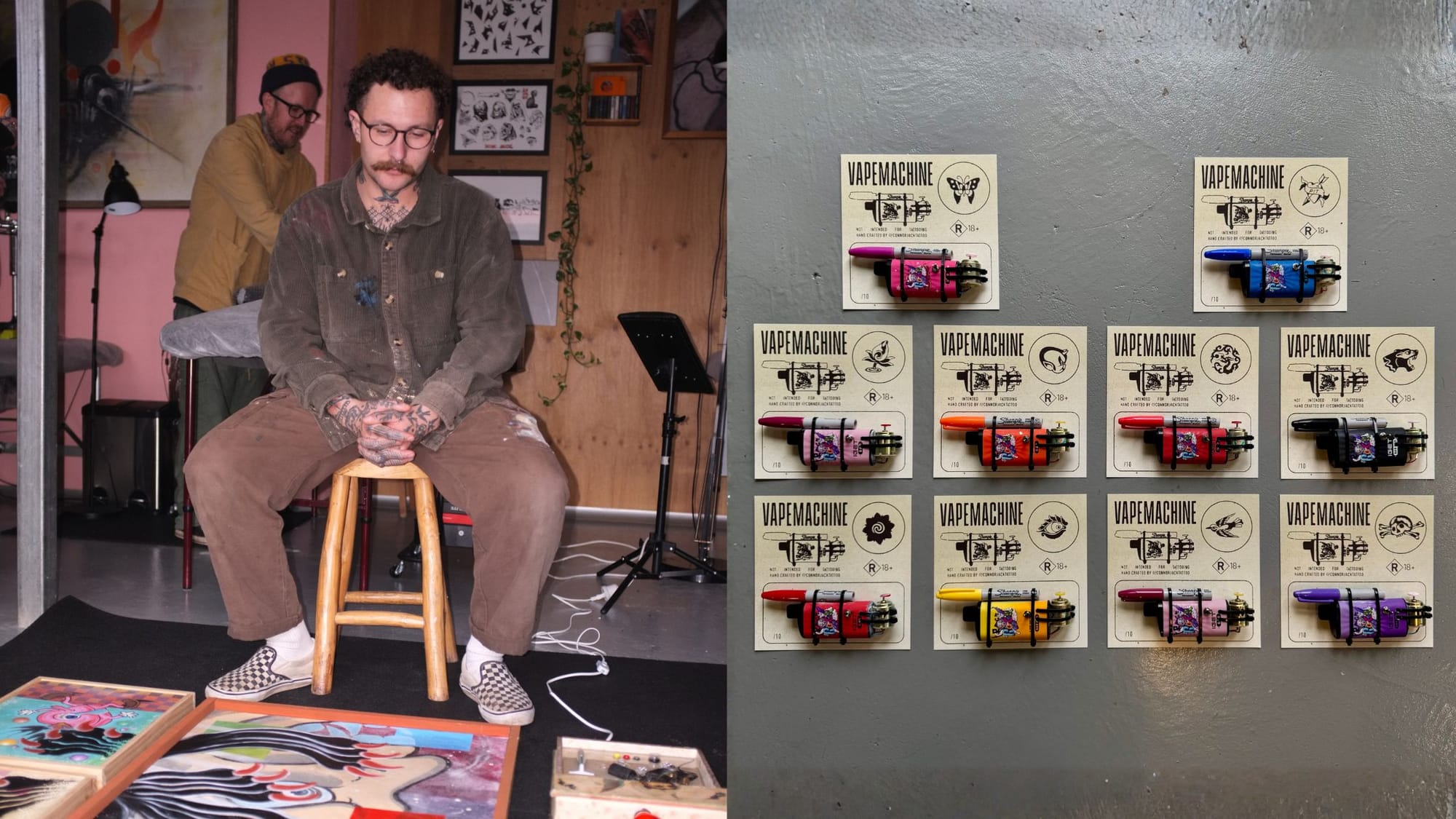
Each machine comes packaged with original flash art — a tattooable design that goes with the machine. The concept started as a small run of ten for an art show and flash day: buy the machine, get the flash tattooed. It resonated more than he expected. So he kept making them.
"I've done two different cards so far and I plan on dropping them in lots of ten with different cards and designs each time," he says. "It's more interactive that way and each person ends up with something different."
No two machines are identical anyway. The vapes vary by brand, colour and batch. That variation — which would be a problem in any production context — becomes the whole point. Every machine is one of one. A functional art piece built from a piece of single-use waste, packaged with a piece of flash, ready to become a tattoo on whoever takes it home.
Connor has tattooed with one himself. A 5 liner, lines with ease. But he's careful about recommending it — not because the machine can't do it, but because most of the people buying them aren't tattooers. Use a proper tube, understand what you're doing, be clean about it. If you're a professional who wants to have a go, he says, reach out.
As for where this goes — he's already working on a version with a potentiometer to regulate voltage, a tube vice for proper needles, something closer to a machine built for actual use. The joke is becoming a genuine project. That's usually how the best things happen.
"In a world where most things are decided for us, art is one of the remaining things that relies on the person viewing it to give it power," Connor says. "Ten different people could see the same painting and all have different feelings towards it. Art has always carried this power and I feel it will for eternity."
He's talking about art as a whole when he says it. But the same can be said about tattooing — and about his own creation. Some people build things because they have to. Connor builds things because he can't not. There's a difference, and you can feel it in the work.
The machines are available via DM. Follow him, watch for the drops.
Connor Cardus (@connorjacktattoo) works at Philip Island Tattoo Studio (@pit.studio_) in Victoria alongside Bugsy (@bugsy3922) and Jack Montgomery (@jmontgomery_tattoo).